Skip to content
YIZE
P.003 / PROJECT2025 — 2026

玉米气生根层级识别|遮挡感知的田间视频表型Maize Aerial Root Tiers · Occlusion-Aware Video Phenotyping

Maize Aerial Root Tiers · Occlusion-Aware Video Phenotyping玉米气生根层级识别|遮挡感知的田间视频表型

从田间视频里逐株数清气生根的层数。真实遮挡下,单帧检测的准确率只有 36.6–45.1%;本文的遮挡感知多帧融合把株级准确率提到 88.9%。

Counting aerial root tiers per plant from field video. Single-frame detection sits at 36.6–45.1% accuracy under real occlusion; the occlusion-aware multi-frame fusion described here takes plant-level accuracy to 88.9%.

角色Role
第一作者First author
类型Type
科研Research
年份Year
2025 — 2026
  • Python
  • PyTorch
  • YOLOv10
  • ByteTrack
  • EfficientNet-B3
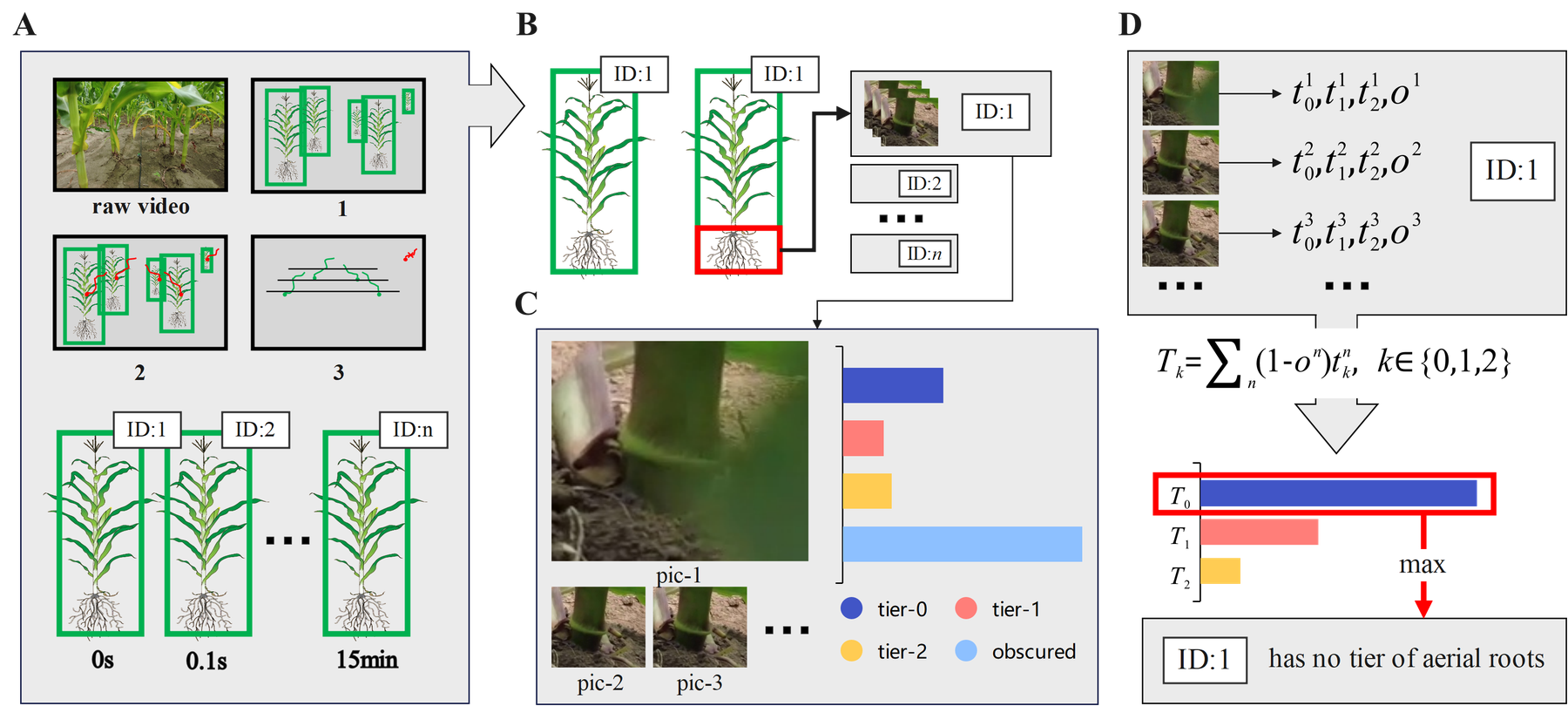
OAMF 管线架构图P.003-A
OAMF 管线架构图
目录Contents

为什么值得数,又为什么难数

一株玉米长几层气生根,这件事被问两遍。第一遍是关于机械支撑:气生根是抗倒伏的结构基础。第二遍关乎某些种质里气生根参与的过程——那是另一条研究线,这里不展开。而在表型这一侧,它还是一个特别不配合自动化的性状——基部结构小,被茎、土壤和杂草挡着,而且每换一个生育期就换一副样子。人工测量的办法是把植株挖出来,代价是这一株的试验到此结束。

这项工作从田间视频里非破坏地量它,并且把遮挡当作中心问题,而不是当作可以用增广抹掉的麻烦。

数据

由 Maizrob 无人地面车采集,覆盖多个生育期与多种条件,得到了一万多株被持续跟踪的植株的根部区域图像。数据是自然田间的,不是布景棚里的:分辨率足够看清植株和根部区域,光照、遮挡和背景则不受控制——这正是问题所在。

管线

  1. YOLOv10-n 逐帧检测单株;
  2. ByteTrack 把跨帧的检测关联成同一个植株身份(它保留低置信度的检测框,这一点在遮挡下是关键);
  3. 从植株框的下四分之一裁出根部区域,交给 EfficientNet-B3 对每一块裁剪图分类;
  4. OAMF(遮挡感知多帧融合)把整段序列的逐帧层级得分聚合起来,给被遮挡拖累的那一帧降权。

第四步是这篇论文的贡献。把每帧的置信度直接相加,Cohen's kappa 只有 0.34;按遮挡加权聚合之后是 0.64(McNemar 检验,p = 7.75 × 10⁻⁴⁴)。

结果

  • 完整管线达到 88.9% 的株级准确率,而单帧 YOLO 基线是 36.6%–45.1%。
  • 在未见过的地点和日期上仍保持在 78% 以上。
  • 吞吐约 每小时 8300 株,在这个规模上人工测量是不可行的。

两个不太显眼但同等重要的选择:

检测器不是为了精度挑的。 在同一份数据上,YOLOv10-n 与 YOLOv10-s 表现相近,而 -n 更小、误检更少,准确率并没有因为容量小而下降。为了部署效率,选 -n。

行归属必须显式处理。 YOLO 的输出不带行信息,检出的植株必须归到正确的垄上,否则邻行的植株会被算进来。判定方式是边界框中点是否连续跨过。

专利

测量方法、系统、存储介质与设备已申请发明专利——一种玉米局部性状获取方法、系统、介质和设备(申请号 202510965643.8,2025 年 7 月受理),申请人为中国农业大学,我是第二发明人。

状态

论文(第一作者,与理学院合作)投至 New Phytologist,目前在审 / 修回中。标注图像集与评测协议在随论文一并准备公开。

这一页不写的

数据集本身。它包含合作地块的田间影像,如果要发,是随论文的数据声明和合作方同意之后发,而不是作为个人网站上的一个下载链接。

关于这些数字

上面的 0.34 → 0.64、88.9%、78%,都写明了自己的条件:kappa 变化来自同一批数据的消融对比,株级准确率对应单帧基线,78% 是跨地点跨日期的留出结果。不同条件之间不合并成一个更好听的倍数。

目录Contents

Overview

The number of aerial-root tiers a maize plant carries matters twice: it is associated with mechanical anchorage, and in some germplasm with the biological nitrogen fixation that aerial roots enable. It is also a phenotype that resists automation — basal root structures are small, occluded by stems, soil and weeds, and look different at every growth stage. Manual measurement means excavating the plant, which ends the experiment for that individual.

This work measures the trait non-destructively from field video, and treats occlusion as the central problem rather than an nuisance to be augmented away.

The pipeline

Video was acquired by a Maizrob unmanned ground vehicle across multiple growth stages and conditions, yielding root-region images from more than 10,000 tracked plants. On top of that:

  1. YOLOv10-n detects individual plants per frame;
  2. ByteTrack associates detections across frames into plant identities;
  3. root regions are extracted, and EfficientNet-B3 classifies each crop;
  4. OAMF — occlusion-aware multi-frame fusion — aggregates per-frame tier scores across the whole sequence, down-weighting frames in which occlusion degrades the view.

The fourth step is the paper's contribution. A naive sum of per-frame confidences reaches Cohen's kappa 0.34; the occlusion-weighted aggregation reaches 0.64 (McNemar test, p = 7.75 × 10⁻⁴⁴). The full pipeline reaches 88.9% plant-level accuracy, against 36.6–45.1% for single-frame YOLO baselines, and holds above 78% on unseen sites and dates. Throughput is roughly 8,300 plants per hour.

The patent

The measurement method, system, storage medium and device were filed as an invention patent — 一种玉米局部性状获取方法、系统、介质和设备 (申请号 202510965643.8, accepted for examination July 2025), with 中国农业大学 as applicant and me as second inventor.

Status

The manuscript — first-authored, with the College of Sciences collaboration — is under peer review at New Phytologist (submitted 2026, manuscript in revision). The annotated image collection and the evaluation protocol are being prepared for release alongside it.

What is not on this page

The dataset itself. It contains field imagery of collaborating plots; it goes out, if it goes out, with the paper's data statement and the collaborators' consent — not as a download link on a personal site.