The timetable lives in the academic-affairs system, assignments in the teaching
platform, and the notices that actually determine what you may or may not do are
scattered across the college site and its WeChat accounts — with the binding
clauses often inside scanned PDF attachments. Finding one fact means opening
several systems; answering one question means reading several documents. This is
not students being lazy. There are simply too many doors, and they do not talk
to each other.
理小助 puts all of it into one conversation: you ask, it finds the document,
calls the service, and returns an answer with its sources attached.
The agent has been in production at the College of Sciences, China
Agricultural University since late June 2026, on desktop and mobile. What
follows are things it does, not things it is meant to do.
Timetable and academic record. With the student's own authorisation it reads
their academic-affairs data into an interactive card: switch academic year,
term, week and view; ask where the clashes are and when there is a free hour,
and it checks week by week against the card's own data; export the whole term as
an ICS file, so a couple of hundred classes arrive in a phone calendar with
rooms and teachers attached. Assignments are summarised out of the teaching
platform one sentence each, with deadlines and submission state. The GPA is
computed against that student's own programme requirements — which course
groups count, per-course marks and credits, and the counting rules laid out
rather than hidden behind the number.
Notices and regulations. Retrieval over a continuously maintained corpus:
905 PDFs converted to readable text, 5,100+ pages of OCR in total. Answers lead
with the conclusion and then list the evidence, and every citation opens the
original document. Whether military theory has to be taken in the first term,
whether one low fitness-test score blocks graduation, when a competition's
registration window closes, how many comprehensive-evaluation points a
provincial first prize carries — it answers to the clause in the notice those
questions actually live in, including the ones people skip, like "only the
highest grade in a series counts".
Campus business and daily life. Dorm electricity balance, live availability
of the washing machines on a floor, the right counsellor for a cohort,
weightings and thresholds compared across the graduate-admission rules, a
certificate card chosen and generated, autumn recruitment and internship
postings gathered by date. If the only thing to hand is a photograph of a paper
document, that works too: it reads the screenshot and then supplies the
conditions the screenshot left out.
The boundary it states. It does not submit homework, does not decide whether
anyone qualifies to graduate, and defers to the college's latest notice on any
policy question. Personal data is used with the owner's authorisation, and key
actions are confirmed by the owner.
Not a chat skin over a language model. The model understands the question and
plans the task, then calls one of ten campus skills and dedicated business
tools as needed — retrieving notices, regulations and attachment text on one
side, connecting to the academic-affairs, teaching and payment systems on the
other through the user's own authorisation — and returns an answer as
interactive cards with traceable sources.
Several of the engineering constraints were forced by real usage rather than
designed up front:
- Session-list responses went from 1.16 MB to 12 KB; a list should not drag the
whole corpus with it.
- Attachments are keyed by file hash and their OCR result is reused, so a file
is processed once.
- Duplicate notices are merged at the data layer rather than by eye — and after
merging, not one source is dropped.
One of the developers, across nearly the whole pipeline: corpus construction and
the OCR governance that keeps it readable, the retrieval and tool layer, the
frontend, and the unglamorous parts — deduplication rules, source traceability,
and the requirement (argued for, not conceded) that every answer must be able to
point at the document it came from.
What is not on this page
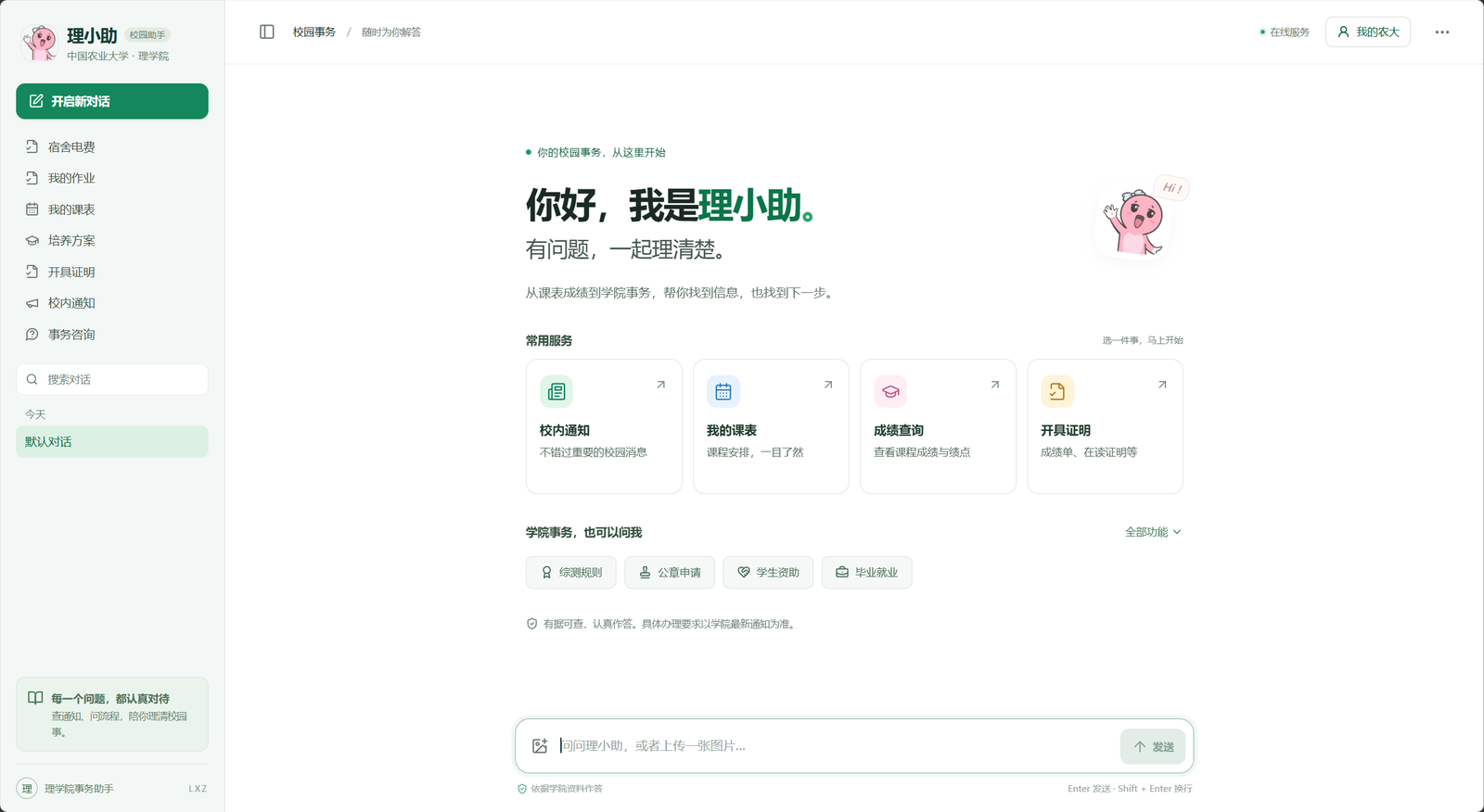
User data, internal prompts and evaluation logs. The screenshots show the
product's empty state, which is what the public is entitled to see.
A few gaps worth naming: some attachments remain unparsed; the programme-
requirement data is still a first version; and the model's answers need
continuous evaluation and correction. The next step is regular updates and a
quality-assessment loop, and then carrying this reusable architecture into more
colleges.